
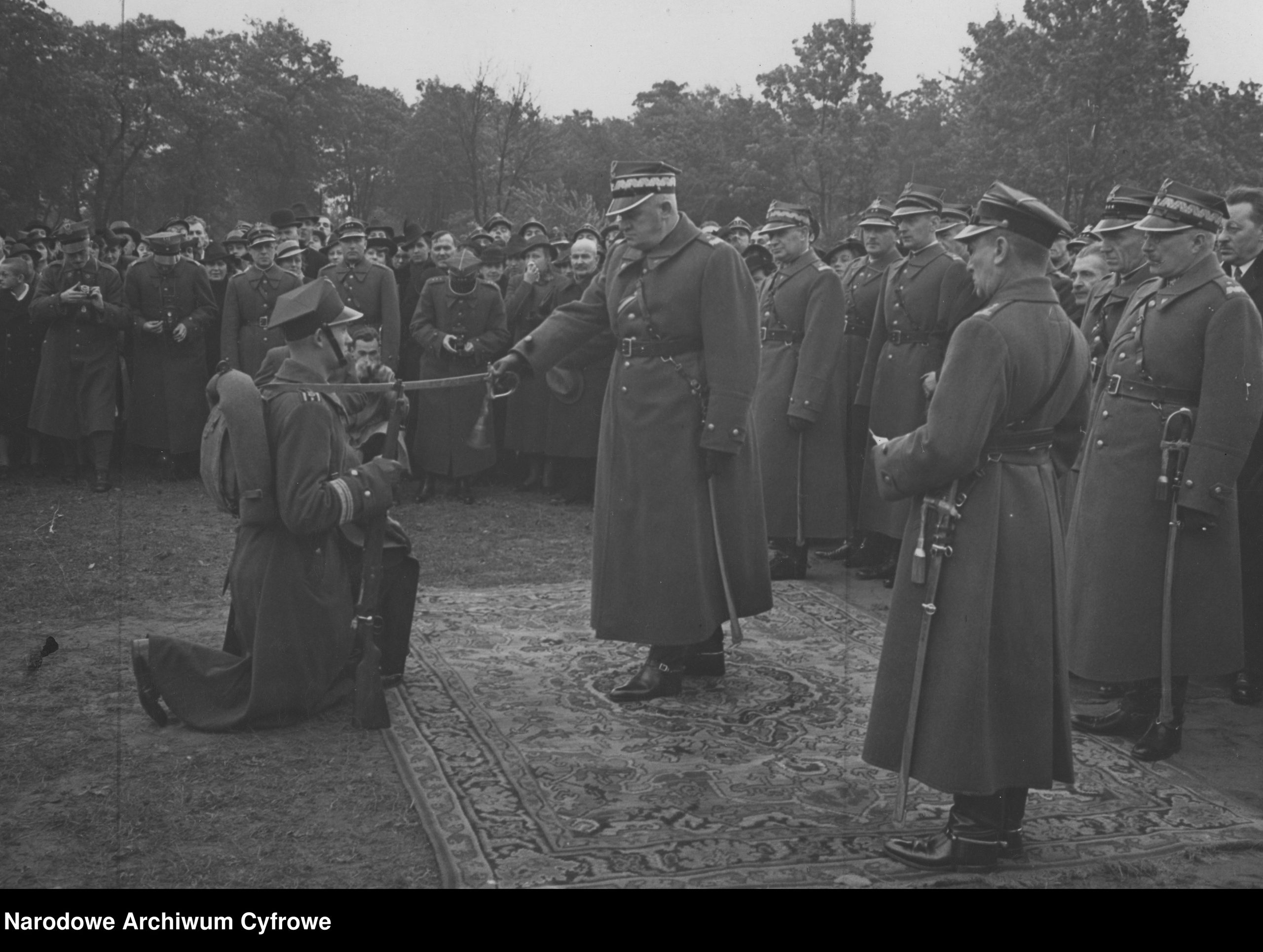
In a photograph held by Poland’s National Digital Archive, General Stanisław Rouppert honors the top student of a cadet school. The young man kneeling before him is Władysław Szczuciński. Less than a decade later, he and his brother Wacław Szczuciński would face the same war and very different fates.
We came across this photograph while working on a very different task. A client had asked Genealogia Polonica to find documents proving the Polish citizenship of his ancestor, Wacław Tytus Szczuciński, who left Poland after the Second World War and eventually became a Canadian citizen. The search led us to far more than papers.
What I found:
- Civil records – Wacław’s birth record from 1919, his parents’ marriage record from 1909, and the birth records of his parents, which together trace the family back to the 1870s.
- Prisoner-of-war card – it records the date and place of capture, his profession (“medical student”) and the date he joined the Polish Army.
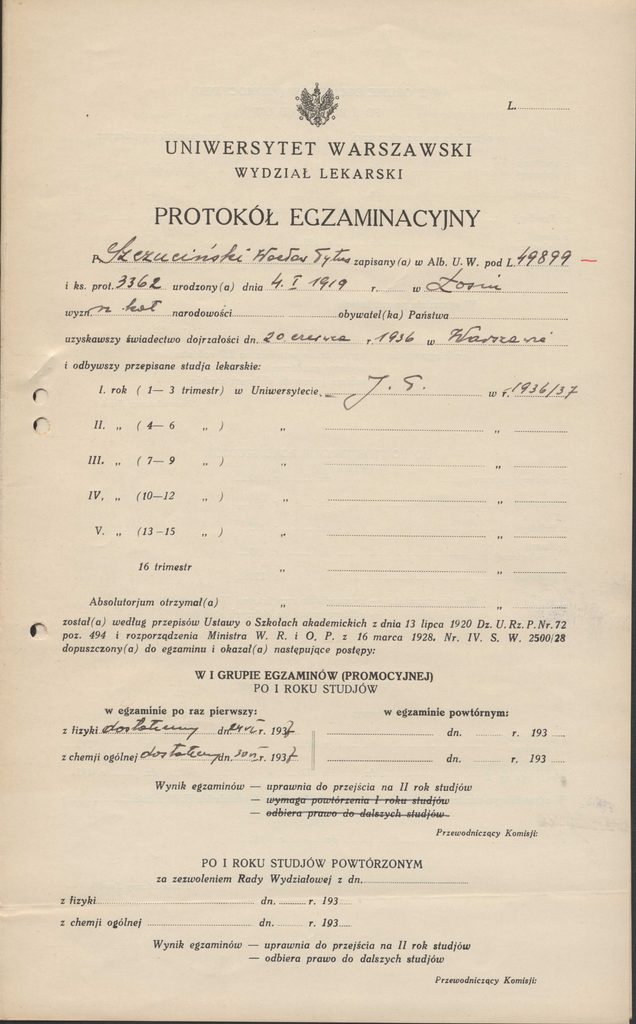
- University of Warsaw records – examination protocols, a certificate confirming three years at the Faculty of Medicine (1936–1939), and entries in the university’s student registers, including his secondary school certificate from the Rejtan Gymnasium.
- Correspondence of Wacław and Władysław Szczuciński from the Central Archives of Modern Records
Birth and marriage records are the backbone of any citizenship case. But they show only that a family existed. University documents shows that ancestor lived, and studied in Poland. Very important information is that there is document confirming that Wacław served in Polish Army.
Both brothers were born in the village of Łoś, near Warsaw. Both studied medicine, and both served in the Polish Army: Władysław as a physician with a motorized heavy artillery unit, Wacław as a cadet of the Sanitary School in Warsaw. In September 1939 both fell into Soviet hands. Wacław was captured on 25 September and held in a camp at Brody, in today’s western Ukraine, where prisoners were put to work building a road. Władysław was sent to Starobelsk. Then came the selection. NKVD officers ordered the officers among the prisoners to step forward. Wacław was about to do so when a Polish soldier standing behind him held him back. It was a small gesture, but it saved his life: the officers who stepped forward were sent to their deaths in the spring of 1940, in what we now know as the Katyń massacre. In 1940, he received a letter back from Władysław. It was the last one. Wacław kept writing and kept searching for him, but no answer ever came. He did not know that Władysław, along with the other prisoners of Starobelsk, had been shot in Kharkiv.
After the Soviet Union and Britain became allies, Wacław was released and joined General Anders’ Polish Army in September 1941. After the war he reached Canada via the United Kingdom, where he started a new life.
How do I check whether my ancestor was a victim of the Katyń massacre?
The Katyń massacre includes the prisoners of Kozielsk, Starobelsk and Ostashkov, shot in 1940 in several places. The Starobelsk prisoners, including Władysław, were shot in Kharkiv, so you should check the lists of victims for the Polish war cemetery in Kharkiv, but you can also check general list murdered at Katyń.
Where can I find the service records of a soldier of Anders’ Army?
It depends on the period. Records of Poles who fought in the West under British command are mostly held by the British Ministry of Defence. Service before 1939 is documented at the Central Military Archives in Warsaw-Rembertów. The Hoover Institution Archives at Stanford hold the Anders collection, with personnel rosters and lists relating to the Polish Army in the Soviet Union. Which one to approach depends on the unit and the dates.
Can university records help prove Polish citizenship?
They can serve as supporting evidence, alongside civil records. Student registers and examination protocols record exact birth dates and places, parents’ names, schools attended and years of study, and they place a person in Poland at a specific time.
